
Training
Yoga teacher training in Cleveland: what 200 hours actually asks of you.
Most people who go looking for one are not sure they want to teach. That turns out to be the normal reason to do it, and it changes what you should be asking about the course.
15 September 2026 · 6 min read
If you have been practicing a few years and something in it has quietly become important to you, there is a point where you want to know what is underneath the thing you keep turning up for. Almost the only route to that is a course with the word teacher in the name, which makes a lot of people hesitate at exactly the wrong moment — they are not planning to quit their job and teach yoga, so they assume the training is not for them.
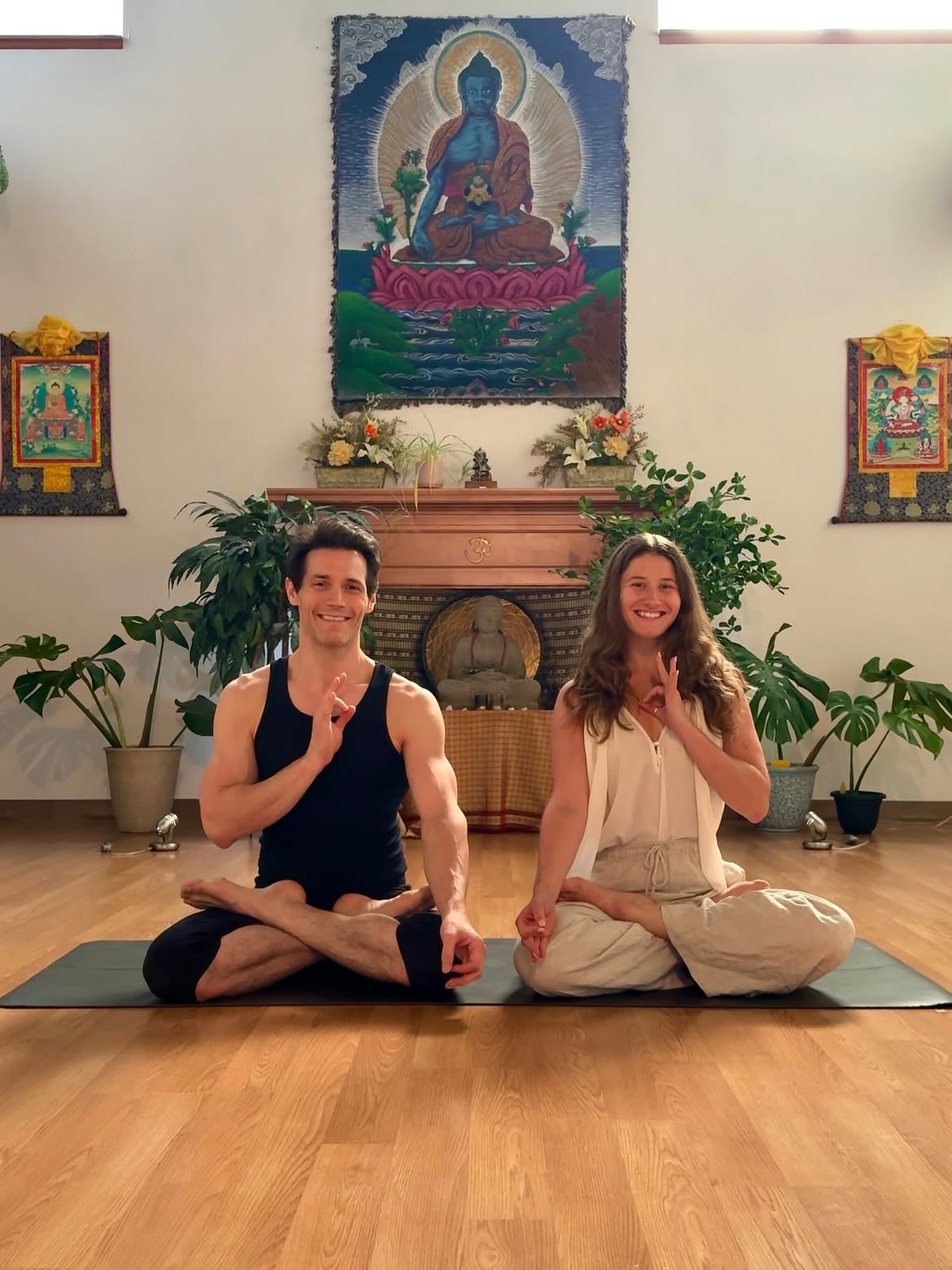
Geoff Knox, who is leading this one with Arden Dalzell, puts it plainly: “The teacher training is really for anybody who wants to deepen their yoga practice.” He has been teaching for eighteen years and practicing for more than twenty, and he is describing most of the people he has taught. Whether you end up at the front of a room afterwards is a decision you get to make in February, not one you have to have made in October.
It helps to know what two hundred hours is actually made of, because the word teacher makes it sound like two hundred hours of learning to teach. It is not. Roughly a hundred of them are the postures themselves — alignment, sequencing, hands-on adjustment, the practice taken apart and looked at. About thirty are anatomy, thirty are philosophy and ethics, twenty-five are teaching methodology and fifteen are practicum, where you actually teach. Four fifths of a teacher training is the deepening. The teaching is the last part, and it is optional in the only sense that matters: nobody is going to make you do it for a living.
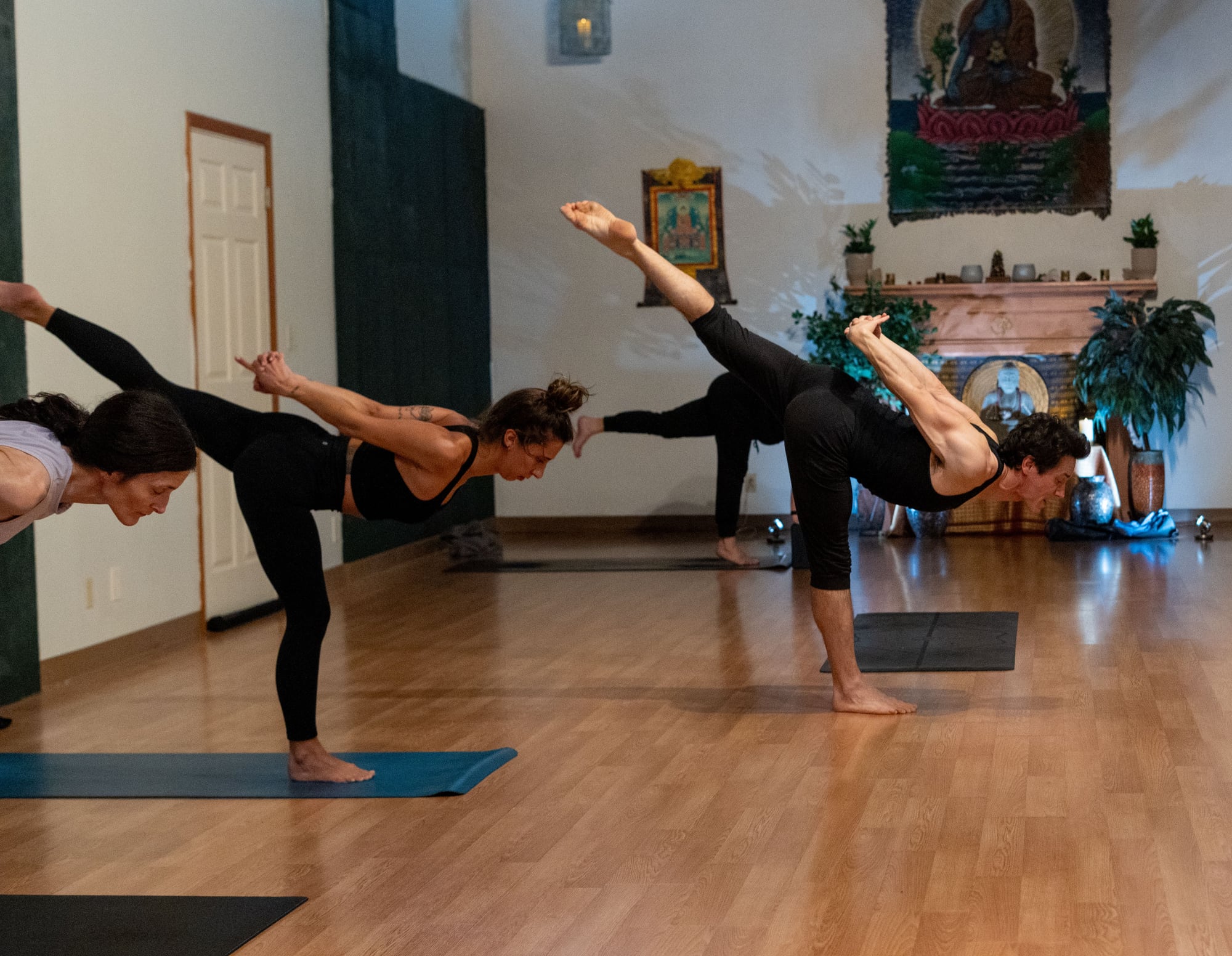
What makes this particular training unusual starts with how a class here is built. Both Arden and Geoff trained in the lineage of Dharma Mittra, which means a class is not a playlist of poses somebody liked the look of. It is five jobs, done every time, each for a reason you can point at. You fold. You twist, left and right. You open the hips. You bend the back. You invert — legs up the wall, on your shoulders, or on your head. Hit those five and you have practiced. Learn why those five, and you can build a class for any room you are ever asked to stand in front of, which is a different and much more durable skill than memorizing a sequence.
The anatomy is Arden's, and it is not the anatomy you may be bracing for. “It's actual medical neuroscience that has been studied,” she says — ten thousand studies on what the practice does to a body and a nervous system, most of them recent. So the module pairs what a joint can do and what it cannot with what brain imaging now shows happening to the nervous system that runs it. Her phrase for the territory is stress relief, and she is deliberate about that: it is the measurable part, and she has no patience for the version of it that is “just the woo stuff that's on Instagram.”
There is one piece of the syllabus almost nobody expects and both of them are protective of: yoga nidra. It sits closer to guided hypnosis than to rest, it runs right through the meditation series, and it is the kind of thing you can only really learn from someone who teaches it often. Alongside it, pranayama and meditation get practiced until they are things you can do and teach, rather than things you have heard of.
Geoff takes the philosophy and the history, and reads all of it through a modern scientific lens. “It kind of helps to demystify a lot of the esoteric practices of yoga,” he says, which is the promise of the whole course in one sentence: the ancient material, without either the credulity or the embarrassment that usually comes with it. He is equally interested in the craft — “what makes a good yoga class, what makes a good teacher, what to do, what not to do.”
And then there is the part most trainings skip entirely. Geoff has studied theater his whole adult life and still works in it. “Being able to communicate to a group is something that is often overlooked in a teacher training,” he says. Standing in front of twenty people and holding their attention for an hour is a learned skill with almost nothing to do with how your own practice looks, and it is the single most common reason a knowledgeable person teaches a flat class.
It is worth saying what none of this requires. “You don't have to be wearing your crystals, following your chakra system and saying your Om mantra to be a yogi,” Arden says. “I love the aesthetic — I'm here for it, it's a great fashion statement. But that has nothing to do with enlightenment.” She is just as clear about where the practice actually lives, which is not on the mat: “It's lived in your daily life. Lead with kindness, lead with compassion, lead with gratitude. That is far more important than any pose you're ever going to do.” You also do not need a headstand, or a particular body, or to already be flexible.
The practical shape of it: the training is run by Westside Yoga and it happens here, in the loft on West 10th, from 24 October to 31 January, in five-hour sessions. A seat is $3,500, enrolled and paid through Westside Yoga, and places are offered by application rather than checkout — which is the part people find unfamiliar and is deliberate. There is no button that takes your money today.
What happens instead is a conversation with Arden or Geoff about where your practice actually is and what you are hoping to get out of a winter of five-hour days. That is a better filter than a credit card for everyone involved, and it is free. If the paragraph about not being sure you want to teach was the one that landed, that is the conversation to have.
It kind of helps to demystify a lot of the esoteric practices of yoga.